 |
 |
|
||
 |
||||
Download Patched Chrome Os Flex Iso File Work «UHD | 1080p»
 Note:
Note:|
Windows 7 users:
Use the EPSON Status Monitor for the driver included in Windows 7, Download the EPSON Status Monitor and its manual from the EPSON Web site. http://www.epson.com |
 Caution:
|
Although you can print to the printer directly connected to the computer in a remote location by using Remote Desktop function* of Windows 7, Vista, or XP, communication error may occur.
* Remote Desktop function: Function which enables a user to access applications or files in a computer connected to the office network from a mobile computer at a remote location. |
Note:|
If you are using a computer running Windows Vista x64 Edition with multiple users are logged on, a communication error message may be displayed when monitoring printers at the same time.
|
Setting up EPSON Status Monitor 3
 |
Open the Utility menu as described in Using the Printer Driver with Windows 7, Vista, XP, 2000, and Windows NT 4.0 or Using the Printer Driver With Windows Me, 98, and 95.
|
 |
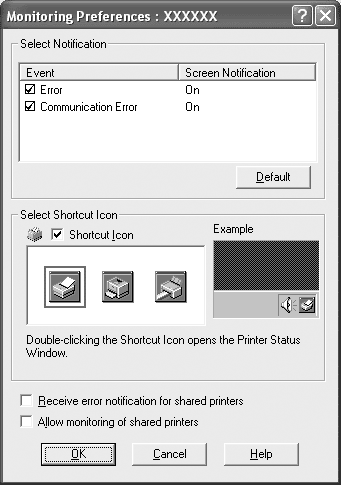
Click the Monitoring Preferences button. The Monitoring Preferences dialog box appears.
|
 |
The following settings are available:
|
Download Patched Chrome Os Flex Iso File Work «UHD | 1080p»
What Chrome OS Flex Is and How It Differs from Chrome OS Chrome OS Flex is a lightweight, managed, cloud-oriented operating system derived from the Chromium OS open-source project and distributed by Google for installation on general-purpose x86_64 PCs and Macs. It keeps the core Chrome OS features—fast boot times, automatic updates, sandboxed browser-based apps, and tight integration with Google services—while removing vendor-specific firmware integrations and some proprietary enhancements that ship on Chromebooks.
Some third-party projects produce Chromium OS-based ISOs or disk images (e.g., FydeOS, CloudReady historically), but these are not identical to Chrome OS Flex and may lack official support or automatic updates from Google. When considering third-party images, weigh the tradeoffs: potential compatibility and update gaps vs. convenience of an ISO. download chrome os flex iso file work
Obtaining the Installer Image Google does not distribute Chrome OS Flex as a user-downloadable ISO file labeled like typical Linux distributions. Instead, the official method is to use the Chrome Recovery Utility (a Chrome browser extension) to create a USB installer from the Chrome OS Flex image hosted by Google. The process ensures you receive an authentic, up-to-date image and avoids tampering risks. What Chrome OS Flex Is and How It
Chrome OS Flex is Google’s lightweight, cloud-first operating system designed to revive older PCs and Macs with a secure, fast environment focused on web apps and cloud services. Unlike Chrome OS for Chromebooks, Chrome OS Flex is distributed as an installer image (not a traditional vendor-supplied ISO), intended to be used via a USB installer. This essay explains what Chrome OS Flex is, how its distribution differs from a conventional ISO, whether and how you can obtain an image, how to create and use a bootable installer, hardware and compatibility considerations, typical deployment workflows, limitations compared to official Chrome OS on Chromebooks, and practical troubleshooting and best practices to make it work reliably. Instead, the official method is to use the
The important distinction is that Chrome OS Flex is designed as an installer image to be written to a USB drive for testing and deployment rather than as a conventional ISO meant for burning to optical media or direct raw-install workflows. Google provides the official installer tools and guidance, and many community builds exist based on Chromium OS, but the supported route is the official USB installer using the official image.
Note:|
Click the Default button to revert all items to the default settings.
|

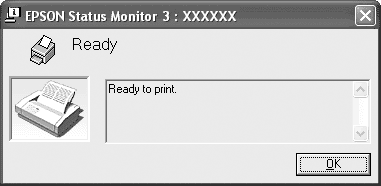
Accessing EPSON Status Monitor 3
 Note:
Note:|
It might not be possible to retrieve the printer status during printing. In this situation, click the EPSON Status Monitor 3 button in the Utility tab, and use the printer with the status window left open.
|
Installing EPSON Status Monitor 3
|
Make sure that the printer is off and that Windows is running on your computer.
|
|
Insert the printer software CD-ROM in the CD-ROM drive.
|
Note:|
If the language selection window appears, select your language.
If the EPSON Installation Program screen does not appear automatically, double-click the My Computer icon, right-click the CD-ROM icon, click Open in the menu that appears, then double-click Epsetup.exe.
|
|
Click Continue. When the software license agreement screen appears, read the statement, then click Agree.
|
 |
Click Custom Install.
|
 |
Click the EPSON Status Monitor 3 button.
|
 |
In the dialog box that appears, make sure that your printer icon is selected, and click OK. Then follow the on-screen instructions.
|
 |
When the installation is complete, click OK.
|