We use cookies to ensure you get the best user experience on our website.Find Out More
Mobile apps, web apps, any platform. One shake, click, or tap gets you video reproductions, network logs, and everything developers need to fix issues fast.
Installation
Bugs
Crashes
Sessions

































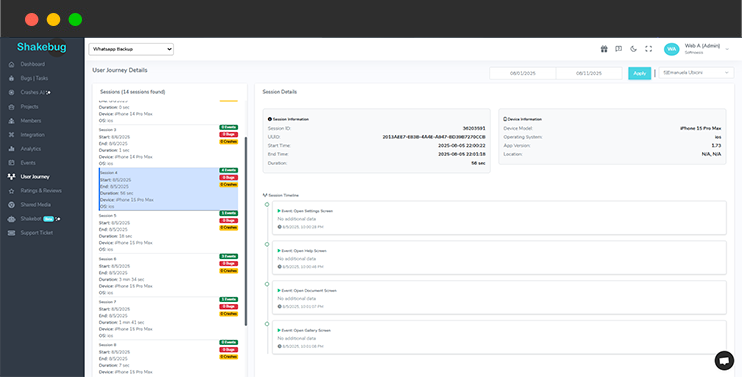
With Shakebug, you see bugs and the complete narrative. Get a clear timeline with our user journey, connecting sessions, events, bug reports, and crash data. See navigation, actions, and exact issue points. Fix issues faster and prioritize work with accurate, actionable insights in the same reporting and monitoring tool.
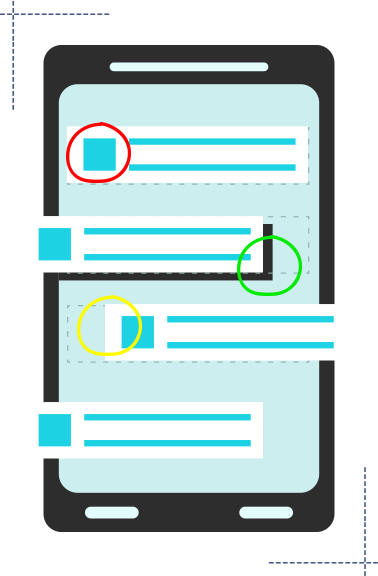
Wave goodbye to the hassle of sorting through countless identical crash reports. With Crash AI, our platform smartly organizes recurring crashes, presenting just one entry that includes all the essential details like the first occurrence, affected devices, OS versions, and much more.

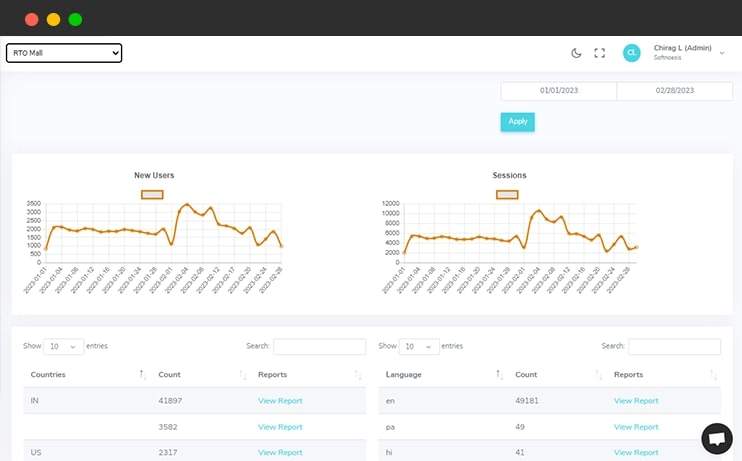
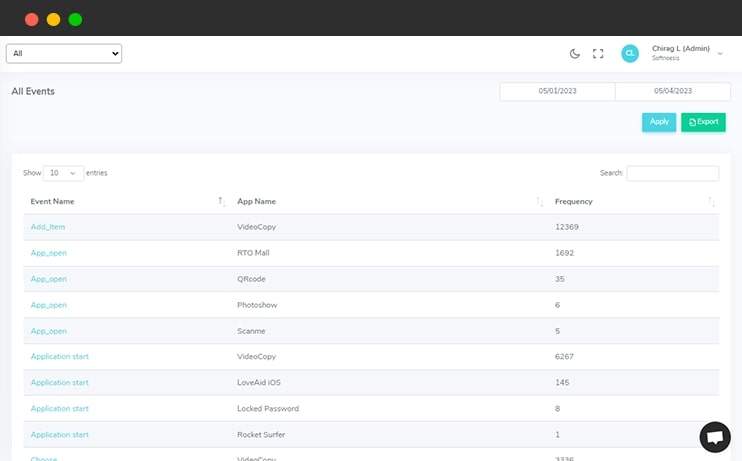
Along with bugs and crash reporting, Shakebug analyzes the application usage in different ways like session, language, countries etc. It also allows users to check analytics in the form of graphical representation over the selection period of time.
Developers/Users can add custom events and values for each action of the application easily where they want. In addition to this, users can also check the session of each event and value in graphical form as well.
Over 0 events tracked in action.
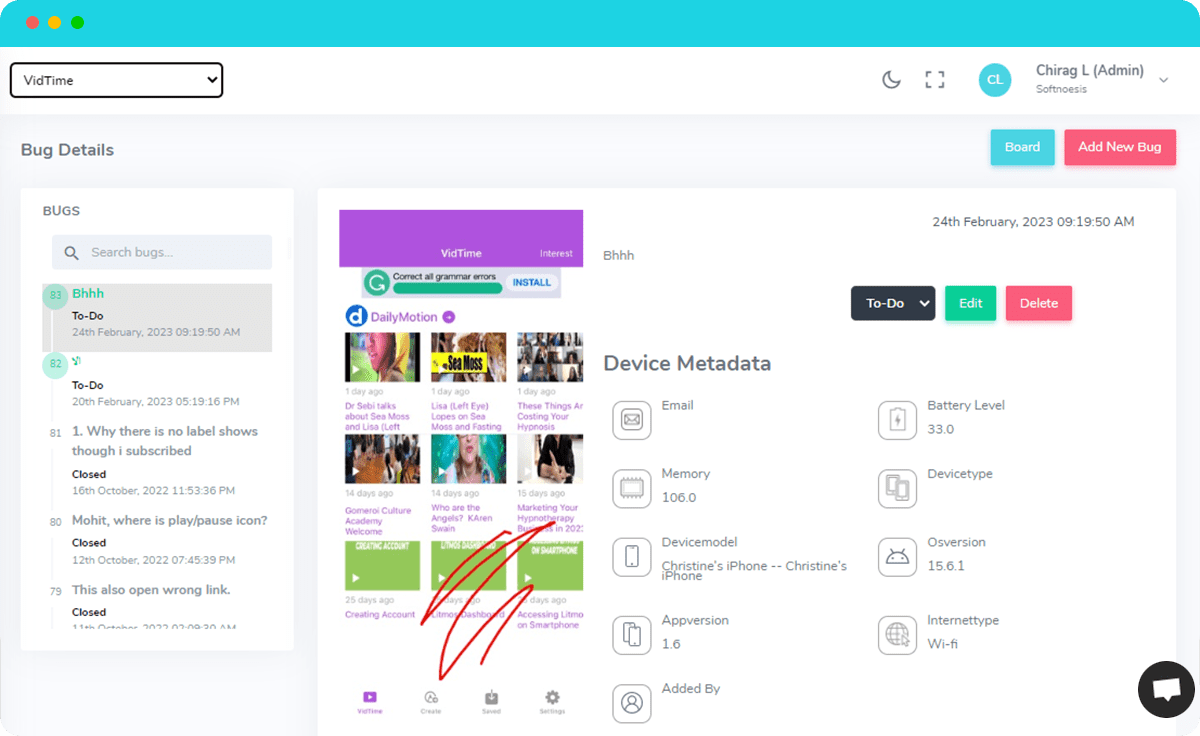
Shakebug helps users to highlight bugs by capturing the screenshot of the screen within a few clicks. This tool minimizes the bug reporting time for your tester and clients.
Shakebug will automatically report the crashes of applications whenever it occurs. Here users don't need to spend time for crash reporting.
Amiibo BIN files are the digitized echoes of those toys. They’re dense bundles of 540-some bytes—little sacred texts—encoding identity, authenticity, and state. To someone who treasures Nintendo’s characters, a BIN file is a ghost in the machine: an intangible copy of a physical presence, a serialized certificate that says “this is Luigi, this is Peach, this is Mario,” and sometimes, “this Mario has time in Bowser’s Kingdom.” Within the world of Super Mario Odyssey, those files take on an additional charm. They’re not just identifiers; they’re keys that tug at the game’s seams, unlocking costumes, amiibo-specific reactions, and Easter eggs that feel like winks from the creators themselves.
If you own an amiibo, the BIN is a secret twin. If you collect them as files, each BIN is a promise: that a small, coded presence can be awakened again—somewhere else, some future day—so long as someone remembers how to listen.
The obsession with Mario Odyssey amiibo BIN files is a kind of modern collecting—a lover’s labor of digital archaeology. Enthusiasts on forums and Discord servers share BINs like postcards from across a fandom, painstakingly cataloging which file yields which hat, which pose, which piece of memory. There’s an artistry to it: extracting the BIN from a figure, reading its signature blocks and user data, and then grafting it into an emulator or a controller that can speak to a Switch. For some, it’s a way to preserve rarity—those Nintendoland Luigi variants or discontinued Smash Bros. releases—capturing their functionality long after the plastic fades.
And yet, for all their promise, BIN files can’t replace the sensuality of the original. The heft of a Toy-Con in the hand, the matte finish of Mario’s cap, the ritualistic tap—these are experiences that zeros and ones only hint at. BINs extend, preserve, and sometimes subvert the amiibo experience, but they are always a mirror image: faithful, but flat; evocative, but ultimately intangible.
There’s a small, almost sacred ritual that takes place in the dim glow of a living room: the careful unlocking of a figurine’s plastic base, the scan of a tiny NFC chip, the whisper of coins in an imagined kingdom. Amiibo figures are, to many, tokens of fandom—tangible avatars to carry into games, to conjure costumes and bonuses with a simple tap. But beneath the cheerful veneer of painted vinyl and Mario’s ever-ready grin lies a quieter, more technical kind of poetry: the BIN file.
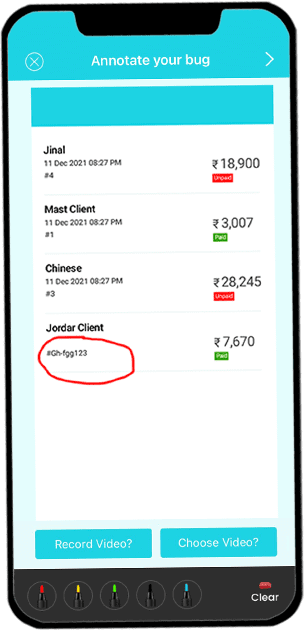
Open your application on your mobile phone and shake it. After that screen will appear where you can highlight the area of the bug.
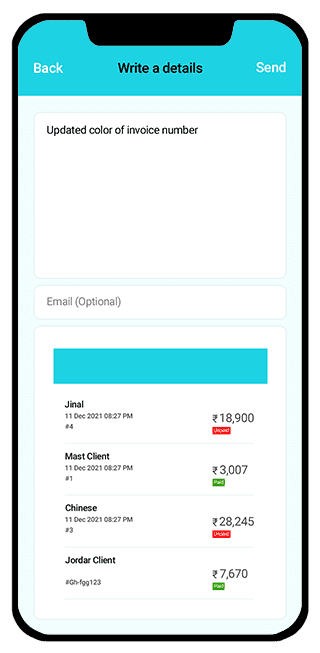
After highlighting the area, a screen will appear where the user can write a bug description which explains the details about bugs or issues.
Once you report the bug, you will get the following screen with bug’s details along with device and OS information to your assigned developers. They can update its status when it is resolved.